

What Is an Energy Management System?
An energy management system (EMS) is a set of software tools that monitor, control and optimize how energy is generated, distributed or consumed — across an electrical grid, a single building, or an entire facility portfolio. The global energy management systems market is projected to grow from $73.49 billion in 2026 to $150.83 billion by 2031, a 15.48% CAGR (Mordor Intelligence) — growth driven largely by rising energy costs and tightening sustainability reporting requirements, not just new construction.
Despite the market size, "energy management system" means genuinely different things depending on who's asking. A utility engineer, a hospital facilities manager and a homeowner with a smart thermostat are all technically describing an EMS — just at completely different scales.
How Energy Management Systems Work
At its core, every EMS follows the same loop: collect data from meters and sensors, analyze that data against expected baselines, then act — either by alerting a human or automatically adjusting equipment. What differs is the scale and the equipment being managed:
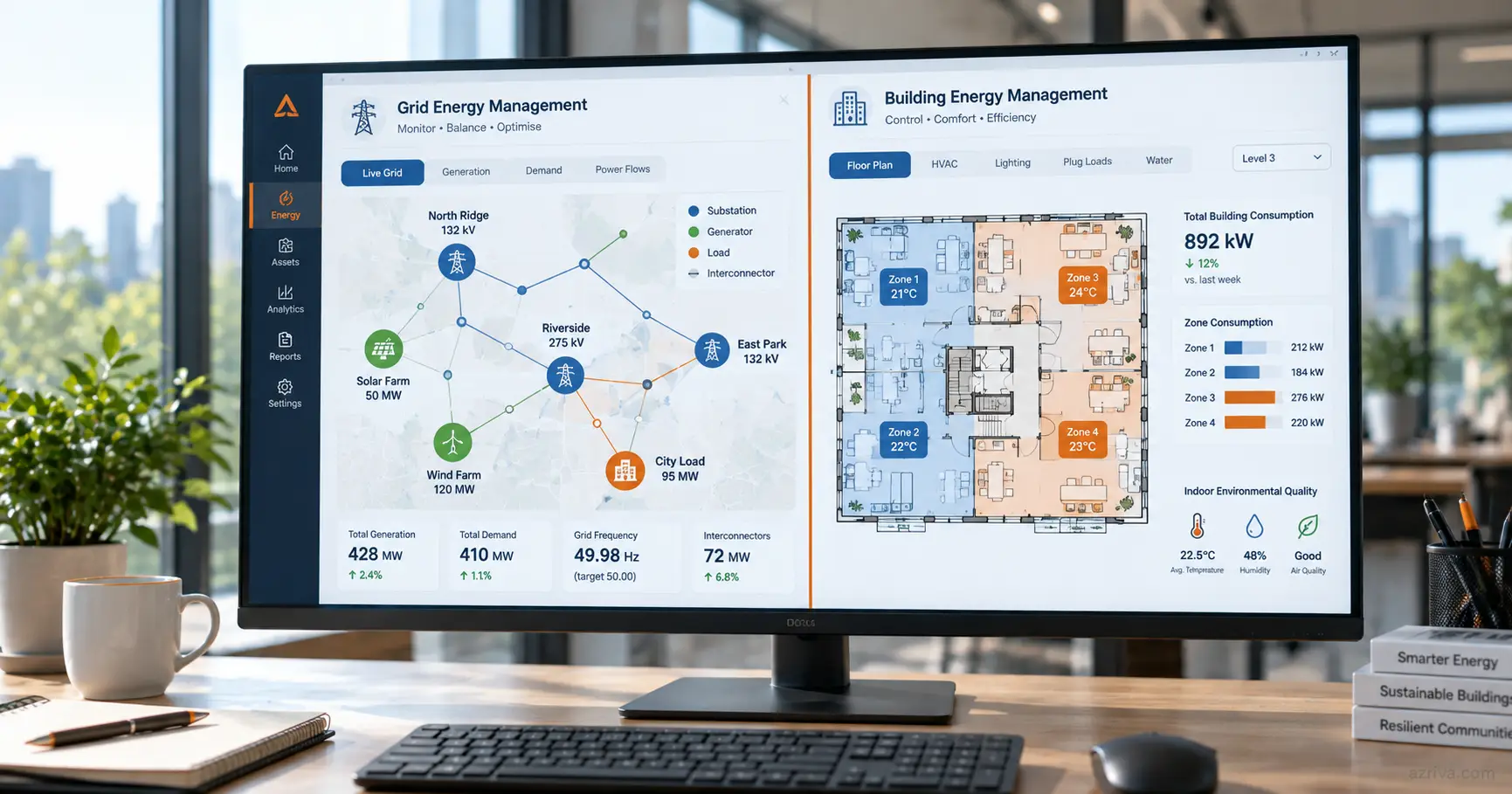
- Grid-side EMS (also called SCADA/EMS) monitors substations, feeders and generation assets across a utility's entire distribution network.
- Building-side EMS monitors HVAC, lighting and equipment across a single facility or a portfolio of buildings.
Both share the same underlying architecture — sensors feed a central platform, which surfaces dashboards to operators and increasingly makes its own optimization decisions.
Grid-Side vs Building-Side: Two Very Different Buyers
This distinction matters more than most guides admit. A grid-side EMS buyer is a utility or DISCOM trying to prevent outages and predict equipment failure across thousands of miles of infrastructure. A building-side EMS buyer is a manufacturer, hospital or commercial property manager trying to cut a monthly utility bill and generate ESG reports without hiring a dedicated data analyst.
If you're evaluating platforms for a utility-scale deployment, our energy sector work covers grid monitoring, smart metering and utility-specific AI use cases in more depth. If you're managing a single facility or portfolio instead, the building-side considerations below are the more relevant half of this guide.
Real-World Examples of Each Type
The grid-side vs building-side distinction is easier to grasp with a concrete picture of each in practice.
Picture a mid-size regional utility serving a few hundred thousand customers, running a grid-side EMS integrated with SCADA. Operators get live visibility into feeder loading, voltage stability and generation output across the distribution network. When a transformer starts showing early signs of thermal stress, the system flags it well before it trips — turning what would have been an unplanned outage affecting thousands of customers into a scheduled maintenance window instead. During storm season, the same system helps prioritize restoration crews by cross-referencing outage reports against customer density and critical infrastructure like hospitals, shortening average restoration time. Grid-side adoption is accelerating for exactly this reason — the global smart grid market is projected to grow from roughly $54 billion in 2026 to over $103 billion by 2031 (Grand View Research), with outage prevention and predictive maintenance cited among the leading use cases.
On the building side, a hospital or manufacturing facility tells a different story. A hospital running a building-side EMS across its HVAC, sterilization and lighting systems can track temperature and humidity compliance in operating theatres and pharmacy cold storage in real time, instead of relying on staff manually logging readings on a clipboard every few hours. A manufacturing plant sees a similar shift — machine-level energy monitoring surfaces which production lines are running inefficiently long before a maintenance engineer would spot it manually, and automated compliance reports save the facilities team days of manual data assembly every audit cycle.
How to Choose the Right Type for Your Organization
Most organizations evaluating an EMS already sense which category they fall into, but it helps to make the distinction explicit before comparing vendors or scoping a custom build.
If you operate or serve an electrical grid — a utility, DISCOM, or independent power producer responsible for delivering electricity to other people — you need a grid-side EMS built around SCADA integration, feeder-level monitoring and outage management. If you occupy or manage a building, facility or campus — a hospital, factory, office portfolio, or retail chain consuming electricity to run your own operations — you need a building-side EMS built around equipment-level monitoring, HVAC optimization and compliance reporting.
If you're still unsure which applies, ask one simple question: is your energy problem about distributing power to others, or consuming power efficiently yourself? Utilities and grid operators solve the first problem. Everyone else — hospitals, manufacturers, retailers, campuses — solves the second. Getting this categorization right early saves you from evaluating vendors and feature sets that were never built for your use case in the first place.
Benefits of an Energy Management System
The core benefits are consistent across both grid-side and building-side deployments:
- Cost visibility — energy typically accounts for around 20% of operating costs in manufacturing facilities (Mordor Intelligence), and most of that spend is invisible without a system tracking it by zone or asset.
- Predictive maintenance — degradation shows up in energy and sensor data long before equipment actually fails.
- Compliance reporting — automated carbon and sustainability reporting replaces manual spreadsheet work every reporting cycle.
- Demand optimization — shifting consumption to lower-cost periods or participating in demand-response programs.
Real-world results back this up: Apollo Hospitals reported utility savings of up to 30% from AI-guided HVAC and boiler sequencing (Mordor Intelligence) — a concrete example of an EMS paying for itself through operational savings alone.
The Role of AI in Modern Energy Management Systems
Traditional EMS platforms relied on fixed thresholds — an alarm fires once a reading crosses a preset limit. The AI-powered energy management software market specifically is forecast to grow from $4.85 billion in 2026 to $11.76 billion by 2031, a 19.38% CAGR (Mordor Intelligence) — nearly 25% faster growth than the broader EMS market, because AI changes what the system can actually do:
- Flagging equipment degradation weeks before a threshold alarm would ever fire
- Recommending HVAC and lighting schedules based on real occupancy patterns instead of fixed timers
- Detecting non-technical losses and anomalies across thousands of data points automatically
- Generating carbon and ESG reports directly from consumption data instead of manual assembly
This is also where most "energy management software" on the market falls short — off-the-shelf platforms ship with generic thresholds because they're built for the average customer, not your specific equipment fleet. An AI-powered system trained on your own sensor and consumption history catches patterns a generic system simply can't see.
Building vs Buying: Should You Build a Custom Energy Management System?
Off-the-shelf EMS platforms are genuinely fine for standardized needs — a single small building with common HVAC equipment rarely justifies custom development. Custom development becomes worth considering once you hit any of these:
- Multiple sites with different equipment vendors that don't share one clean data format
- Compliance requirements specific to your jurisdiction or industry that generic platforms don't fully cover
- A need for customer-facing or field-technician mobile apps, not just a back-office dashboard
- Wanting to own your consumption data and source code rather than renting access indefinitely
If any of that sounds familiar, a custom mobile app paired with a purpose-built backend is usually the more durable investment — one fixed cost instead of per-site or per-meter licensing that compounds every year you keep using the platform.
How Much Does It Cost to Build a Custom Energy Management System?
Costs vary significantly by scope. A focused MVP — a single-facility dashboard with consumption tracking and alerts — typically starts around $7,000-$10,000. A full platform with AI-powered predictive maintenance, multi-site support and automated compliance reporting generally runs $20,000-$45,000, depending on how many existing systems (BMS, ERP, utility billing) need integrating. Most reputable mobile app development partners will quote this as a fixed price once requirements are scoped — not an open-ended hourly estimate.