
SEO vs Paid Ads: Understanding the Core Difference
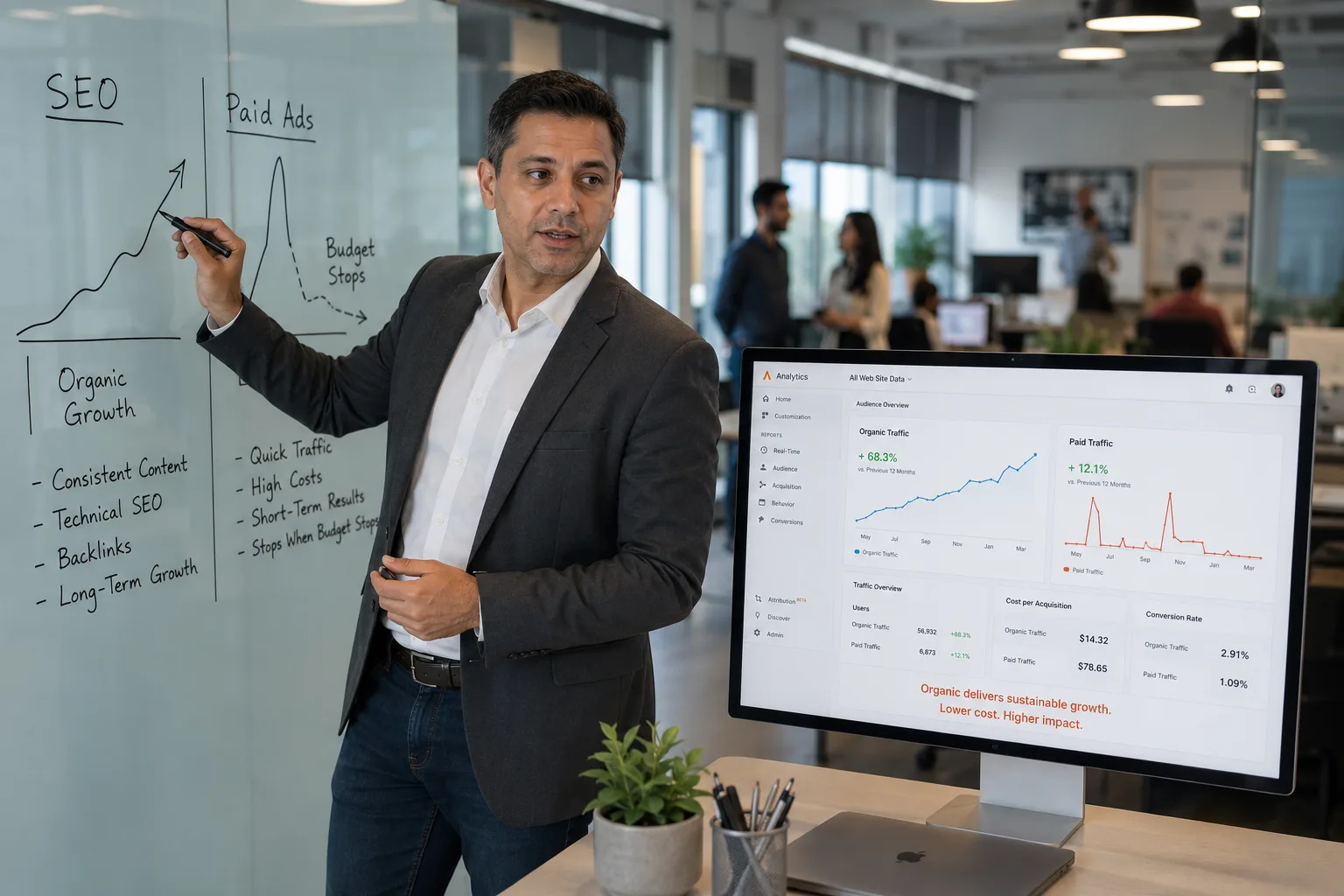
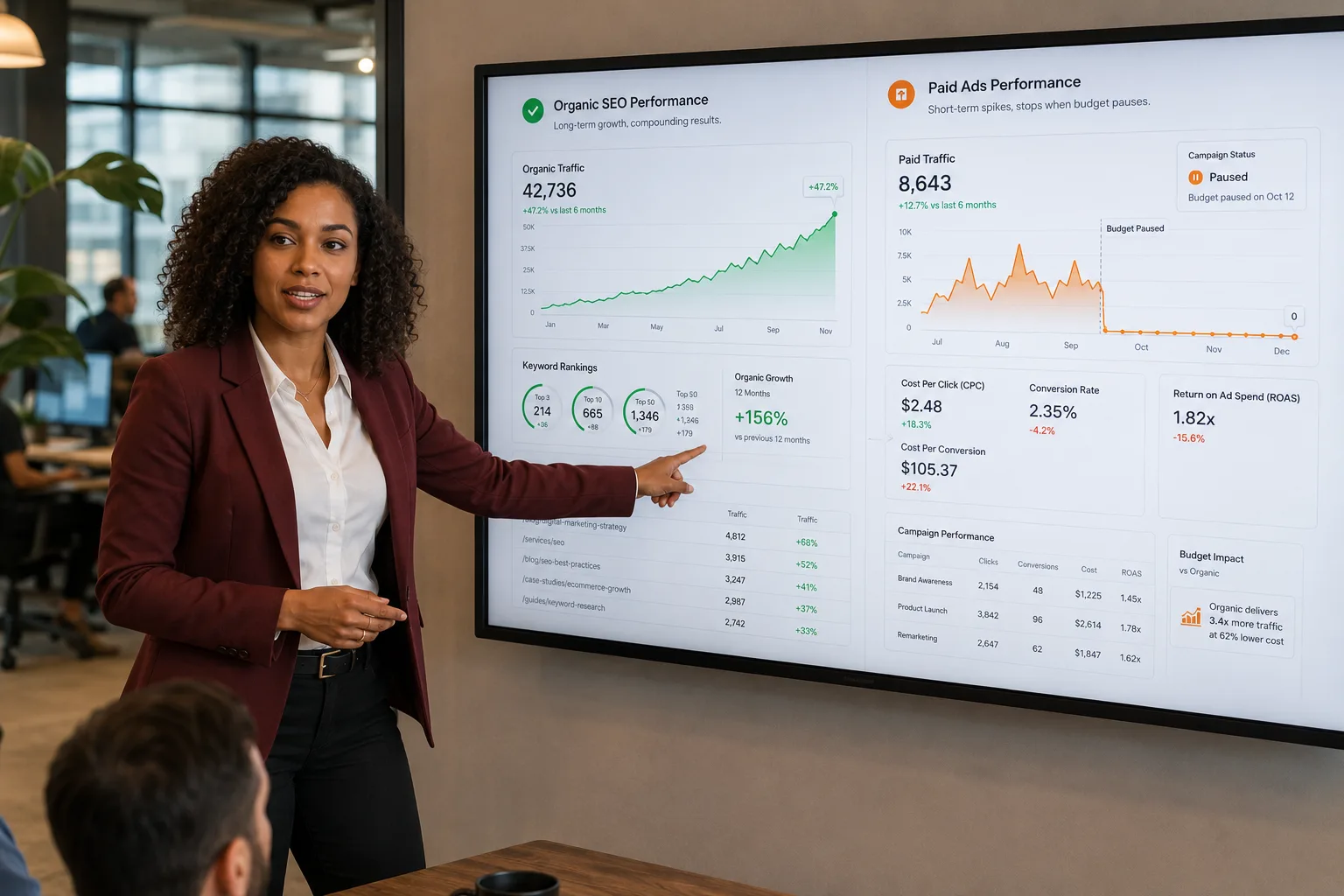
Search Engine Optimisation — SEO — is the practice of improving your website’s visibility in organic search results. When someone searches for a product or service you offer, SEO determines whether your website appears on the first page of results without you paying for that placement. Done well, organic traffic compounds over time — the content and authority you build today continues driving traffic for years.
Paid advertising — primarily Google Ads and Meta Ads — places your business in front of potential customers immediately, in exchange for a fee every time someone clicks your ad. Traffic starts the moment your campaign goes live and stops the moment you stop paying.
Both are legitimate, effective digital marketing strategies. The question is not which is better in the abstract — it is which is right for your business at this point in time, with your specific budget, timeline, and growth objectives.
SEO vs Paid Ads: Direct Comparison
Time to Results
Paid ads deliver results immediately. Your ad goes live, it appears in search results, traffic arrives. For businesses with immediate revenue pressure — a new product launch, a seasonal campaign, or a business that needs leads this month — paid ads are the only option that delivers on that timeline.
SEO is a long-term investment. A new website targeting competitive keywords should expect 3–6 months before meaningful organic traffic begins, and 6–12 months to reach rankings that drive significant volume. This timeline is not a flaw — it is the nature of how search engines evaluate authority and trust. The patience required is the barrier that makes organic rankings valuable once achieved.
For businesses building mobile apps or launching digital products, the typical approach is to use paid ads to drive early user acquisition while building SEO foundations simultaneously — so that organic traffic reduces paid dependency over time.
Cost Structure
Paid ads operate on a cost-per-click model. Every visitor costs money. When your budget runs out, your traffic stops. The economics work if your customer lifetime value exceeds your cost per acquisition — but the cost never goes away. Scaling paid ads means scaling budget proportionally.
SEO has high upfront investment — content creation, technical optimisation, link building — but the ongoing cost per visitor decreases over time as rankings compound. A piece of content that ranks on page one drives traffic for years with minimal ongoing cost. The total cost per acquisition from organic search typically falls 60–80% below paid acquisition cost over a 24-month horizon.
For businesses evaluating AI-powered digital products, where customer lifetime value is high and the sales cycle is long, SEO’s compounding economics almost always produce better long-term ROI than paid ads alone.
Traffic Quality and Intent
Search intent matters enormously for conversion rates. Both SEO and paid ads can target high-intent keywords — people actively searching for a solution you provide. The difference is in the trust signal.
Organic search results carry an implicit trust signal — users know you cannot simply pay to appear there. Studies consistently show that organic results receive more clicks than paid results for the same keyword, and organic visitors convert at higher rates for considered purchases. For high-ticket services, enterprise software, and professional services, organic trust is a genuine conversion advantage.
Paid ads excel at capturing transactional intent — people ready to buy now. E-commerce, local services, and short sales cycle products benefit disproportionately from paid ads because the immediate availability and promotional messaging of paid ads matches the fast purchase decision these products require.
Scalability
Paid ads scale immediately and predictably — double the budget, approximately double the traffic. This scalability is valuable for businesses with proven unit economics and capital available to deploy. It is also a vulnerability — a platform policy change, an account suspension, or a budget cut eliminates your traffic overnight.
SEO scales more slowly but more durably. Organic rankings built over 12–24 months create a traffic asset that does not disappear when you reduce spending. For businesses building long-term brand equity and sustainable customer acquisition, SEO’s durability is a strategic advantage that paid ads cannot replicate.
Targeting Precision
Paid ads offer extraordinary targeting precision — demographics, interests, behaviours, custom audiences, remarketing lists, and lookalike audiences. You can reach exactly the person you want, when you want, with a message tailored to their specific situation. This precision is particularly valuable for businesses with a well-defined ideal customer profile and a product with a narrow audience.
SEO targeting is keyword-based — you create content that matches what your target audience searches for. The precision is lower than paid ads but the reach is broader — organic content can rank for hundreds of related queries that you never explicitly targeted, creating discovery pathways that paid campaigns cannot replicate.
When to Prioritise Paid Ads
Paid advertising is the right priority when:
- You need leads or sales immediately — within days or weeks, not months
- You are launching a new product and need market validation quickly
- Your business has a seasonal peak that requires capitalising on a short window
- You have strong unit economics and capital available to deploy profitably
- Your target audience is highly specific and benefits from paid targeting precision
- You are promoting a time-sensitive offer, event, or promotion
When to Prioritise SEO
SEO is the right priority when:
- You are building a long-term digital presence with sustainable economics
- Your content naturally answers questions your target audience searches for
- You operate in a considered purchase category where organic trust influences decisions
- Your paid acquisition costs are high relative to customer lifetime value
- You want to reduce dependency on paid platforms over time
- You are building authority in a specific topic area or industry niche
The Integrated Approach
The most effective digital marketing strategy for most businesses is not a choice between SEO and paid ads — it is a structured integration of both.
Paid ads provide immediate traffic, conversion data, and revenue while SEO compounds in the background. SEO data — which keywords drive conversions, which content topics perform best — informs paid campaign targeting. Remarketing campaigns re-engage visitors who arrived through organic search. The two channels reinforce each other when run as part of a unified strategy.
The allocation between paid and organic investment should shift over time. Early stage businesses should weight towards paid for speed. Established businesses with strong SEO foundations should weight towards organic for efficiency. The right balance depends on your current position, your growth objectives, and your available capital.
What This Means for App and Software Businesses
For businesses building mobile apps, SaaS products, or AI-powered platforms, the SEO vs paid ads question has specific implications:
App Store Optimisation — ASO — is the mobile equivalent of SEO, and is consistently underinvested relative to its impact. Paid user acquisition through Meta and Google App Campaigns delivers immediate installs but at costs that rarely achieve long-term profitability without strong organic discovery supplementing paid.
For B2B software and services businesses, content-led SEO — detailed guides, comparison articles, and problem-focused content — builds the kind of trust and authority that converts enterprise buyers. Paid ads drive awareness and retargeting but rarely close enterprise deals alone.
The AZRIVA View
We work with businesses across USA, UK, Canada, and India who are making exactly this decision — where to invest their digital marketing budget for maximum return. Our view: start with paid ads to validate demand and generate early revenue, invest in SEO simultaneously to build long-term organic equity, and shift the balance towards organic as rankings compound and cost per acquisition from paid decreases.
If you are building a digital product and want an honest assessment of how to structure your digital marketing investment, our team can help you think through the right approach for your specific business situation — and build the mobile app or digital platform that your marketing strategy needs to convert traffic into customers.