

What Is an AI Agent for Business?
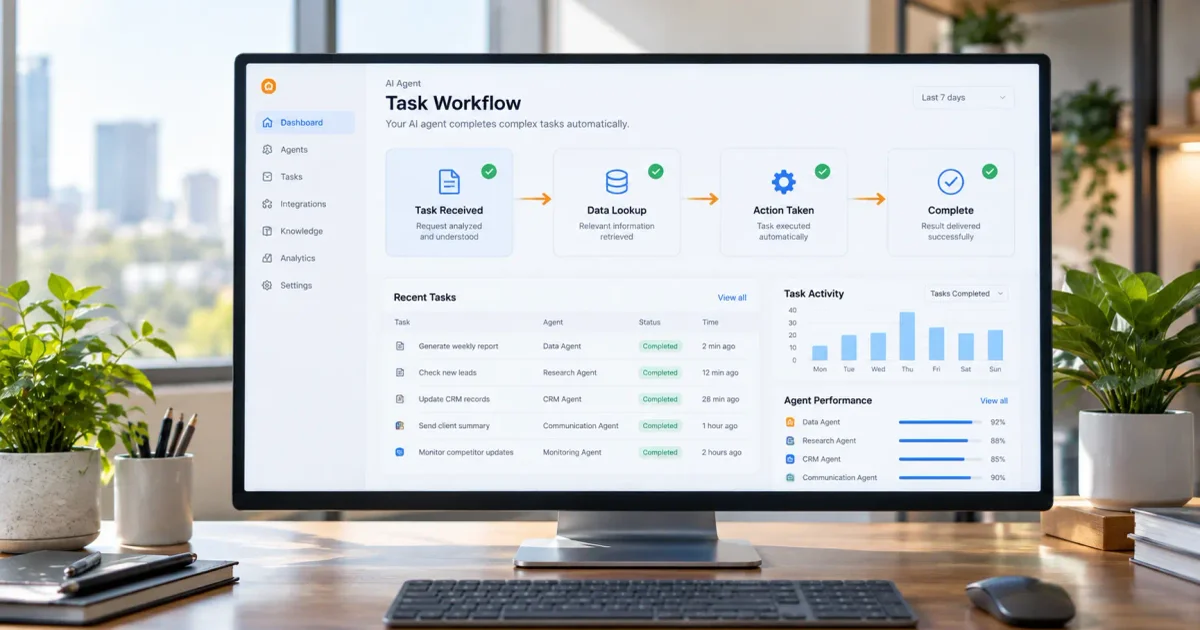
An AI agent is software that can plan and take multi-step action toward a goal with limited step-by-step human instruction — not just answer a question, but decide what to do next, use tools to do it, and keep going until the task is done. The distinction that matters for a business owner: a chatbot answers what you type; an agent finishes what you assign.
Concretely, an agent might read an incoming support ticket, check your order database, issue a refund within pre-set limits, and log the resolution — without a human touching any of those individual steps. The human sets the boundaries; the agent executes inside them.
That's also what separates an agent from the typical "smart" feature in AI-powered app development today — a recommendation carousel or a summarize button responds to one request, while an agent carries a task through several steps on its own.
What Actually Changed, Specifically
Before this API, building a genuinely durable AI agent — one that remembers context across sessions, safely calls multiple tools, and can hand off sub-tasks — required stitching together your own infrastructure on top of a raw model. OpenAI's Agents API packages that scaffolding as a product: sessions persist, tools are called through a standard interface, and subagents can be spun up for specialized sub-tasks, all with a choice of where the execution actually runs.
Gartner forecasts that 40% of enterprise applications will include task-specific AI agents by the end of 2026, up from under 5% in 2025.
The practical effect: the gap between "we should use AI agents" and "we have shipped one" just got a lot smaller for teams without a dedicated AI research group.
Real Business Use Cases for AI Agents
The use cases seeing genuine production adoption right now, not just pilots:
- Customer support triage and resolution — reading tickets, checking account data, resolving common cases end-to-end, escalating only genuine exceptions
- Sales development and lead qualification — researching inbound leads, scoring fit, drafting personalized outreach, scheduling calls
- Internal operations — pulling data across multiple internal tools to answer a manager's question or generate a report that used to take an analyst half a day
- Software engineering support — reviewing pull requests, writing tests, and flagging likely bugs before a human reviewer looks at the code
Not all of these live in back-office dashboards, either. Support resolution and lead follow-up increasingly surface as features inside customer-facing apps, which is why agent capability is becoming part of the brief for mobile app development, not just internal tooling.
The Part Most Coverage Skips: Agents Fail Often
Here's the balance most "AI agents will change everything" articles leave out: Gartner also predicts more than 40% of agentic AI projects will be cancelled by 2027 — mostly from unclear business value, unmanaged cost, or inadequate risk controls, not from the technology failing to work. Gartner's 2026 CIO and Technology Executive Survey found only 17% of organizations have deployed AI agents to date — even though more than 60% expect to within the next two years. That gap between ambition and execution is the real story right now, more than any single industry's adoption rate.
The gap isn't capability — it's scoping. Projects that start with a narrow, well-defined task (a specific support workflow, a specific report) succeed far more often than open-ended "give the agent access to everything and see what happens" builds.
Should You Build an AI Agent, or Buy One?
This is the actual decision most businesses are facing right now, and the honest answer depends on scope:
- Off-the-shelf agent tools (built into your CRM, helpdesk, or existing SaaS) make sense when your use case matches what the vendor already built for — customer support and sales tooling are the most mature categories.
- Custom-built agents make sense once you need the agent to work across systems that don't share one vendor, follow business logic specific to how you operate, or handle a workflow no off-the-shelf tool has modeled yet.
If you're weighing this for your own operations, a custom AI solution built around your actual workflows — not a generic template — is usually what closes that ambition-to-execution gap: the projects that succeed are the ones scoped tightly around a real, measurable task from day one.
How This Fits Into a Broader AI Strategy
AI agents rarely arrive alone — they usually sit on top of existing AI integration work (connecting the agent to your actual data and tools) and often complement rather than replace a generative AI feature you may already have shipped, like a chatbot or content tool. Treating agent development as one piece of a wider AI roadmap — not an isolated experiment — is what separates the 40%+ of projects that get cancelled from the ones that scale.
Getting Started the Right Way
If you're considering an AI agent for your business, the pattern that works: pick one narrow, well-understood workflow with a clear success metric, build a scoped pilot, measure real time saved or cost avoided, then expand. Our AI agent development team follows exactly this approach — starting from a fixed-price, tightly scoped build rather than an open-ended engagement, specifically to avoid the "unclear value" failure mode Gartner flags as the top reason agent projects get shelved.
And if you already have a customer app, that's often the most practical place to start — users increasingly expect the apps they use every day to act on their behalf, and adding a scoped agent to an existing custom mobile app is usually faster than launching a separate tool.